Candidates,
You have made it through the journey of student teaching. At this point, many of you have encountered a multitude of things that have happened throughout this experience that has allowed you to become better teachers. Every aspect may not have been desirable, yet many may have been simply splendid. The most important thing to remember is that every thing that happens can be a learning experience; whether of what to do or what not to do. This experience has been one of the most challenging for me as a US, but I am proud of how well you all adjusted and kept on striving towards your goals. Many of you also have experienced some difficult situations, and I am very glad you all were persistent and did not give up. This time next week you all will be graduates of The University of Southern Mississippi and that is a privilege that you should carry in a proud manner. Since I will not have the opportunity to meet with you all on tomorrow, I am posting on the blog so that you all will have an opportunity to share your last thoughts. Below you will find some questions that I am asking you to respond to in relation to yourself during this student teaching experience. I am looking forward to reading your post, and I have appreciated the opportunity to be your supervisor. Please call or email if I can assist you in any way
Thinking back to our first meeting, I described the journey of student teaching, in which I told you that you never know how things will turn out. Based on your experiences, have your experiences been what you expected or what you did not expect? Explain.
If you could use one word to describe how you feel during this final transition from student to teacher, what would that word be?
What has been the most important thing that you have learned about yourself throughout this experience.
What are your future goals as an educator? What has influenced those goals?
Thank you all for being great student, and I wish you all well in your future endeavors.
Kerri Johnson-Jones, US
Sunday, May 5, 2013

Tuesday, April 9, 2013


Differentiated Instruction
After converstations and completing first evaluations there are still some gray areas in some of your lessons plans related to differentiated instructions. I have added some resources to this blog related to that topic. Please let me know if you have any questions.
Differentiated Programming
What it is...
• Providing multiple assignments within each unit, tailored for students of different levels of achievement.
• Allowing students to choose, with the teacher's guidance, ways to learn and how to demonstrate what they have learned.
• Permitting students to opt out of material they already know and progress at their own pace through new material.
• Structuring class assignments so they require high levels of critical thinking but permit a range of responses.
• Having high expectations for all students.
• Creating learning centers with activities geared to different learning styles, readiness and levels of interest.
• Providing students with opportunities to explore topics in which they have strong interest and find personal meaning.
What it isn't
• Assigning more work at the same level to high-achieving students.
• Requiring students to teach material they have mastered to others who have not mastered it.
• Giving all students the same work most of the time.
• Grouping students into cooperative learning groups that do not provide for individual accountability or do not focus on work that is new to all students.
• Focusing on student weaknesses and ignoring student strengths.
• Using only the differences in student responses to the same class assignment to provide differentiation
Copyright of Dr. Susan Allan
Links
Sunday, February 17, 2013
Dispositions
Candidates,
In being a teacher, not only is it important to be able to plan and provide instruction; but dispositions is a major aspect in the role of a teacher. Please view the information below related to dispositions.
Additional Resource
YouTube video related to dispositions- http://youtu.be/IQaZLpDc3Og
The Teacher
Dispositions Index (TDI) aligned with the dispositions of effective teachers as
specified under INTASC’s (1991) Model Standards for Beginning Teacher Licensing
and Development. The Model Standards for Beginning Teacher Licensing and
Development include 10 principles and their corresponding dispositions.
•
Principle 1: The teacher understands the central concepts, tools of inquiry,
and structures of the discipline(s) he or she teaches and can create learning experiences
that make these aspects of subject matter meaningful for students.
•
Principle 2: The teacher understands how children learn and develop and canprovide
learning opportunities that support their intellectual, social, and personal development.
•
Principle 3: The teacher understands how students differ in their approaches to
learning and creates instructional opportunities that are adapted to diverse learners.
•
Principle 4: The teacher understands and uses a variety of instructional
strategies to encourage students’ development of critical thinking, problem
solving, and performance skills.
•
Principle 5: The teacher uses an understanding of individual and group motivation
and behavior to create a learning environment that encourages positive social
interaction, active engagement in learning, and self-motivation.
•
Principle 6: The teacher uses knowledge of effective verbal, nonverbal, and media
communication techniques to foster active inquiry, collaboration, and supportive
interaction in the classroom.
•
Principle 7: The teacher plans instruction based upon knowledge of subject matter,
students, the community, and curriculum goals.
•
Principle 8: The teacher understands and uses formal and informal assessment strategies
to evaluate and ensure the continuous intellectual and social development of
the learner.
•
Principle 9: The teacher is a reflective practitioner who continually evaluates
the effects of his/her choices and actions on others (students, parents, and
other professionals in the learning community) and who actively seeks out
opportunities to grow professionally.
•
Principle 10: The teacher fosters relationships with school colleagues,
parents, and agencies in the larger community to support students’ learning and
wellbeing. (INTASC, 1991)
Welcome Candidates
Candidates,
Here is the class blog that I promised you. Sorry for the delay, but I did not want you all to feel overwhelmed. This is just a resource, and you may participate only if you would like to. Just remember to be respectful to others with your post. I hope you enjoy!
Here is the class blog that I promised you. Sorry for the delay, but I did not want you all to feel overwhelmed. This is just a resource, and you may participate only if you would like to. Just remember to be respectful to others with your post. I hope you enjoy!
Monday, October 1, 2012
Aligning Assessments with Objectives
This is a great resource related to aligning assessments with objectives. PLEASE VIEW!!!!!
http://www.cmu.edu/teaching/assessment/howto/basics/objectives.html
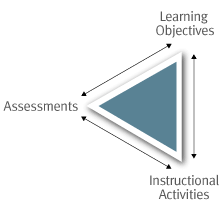
http://www.cmu.edu/teaching/assessment/howto/basics/objectives.html
Grading vs. Assessment
Click on the link below and read the article related to grading vs. assessments. Tell me your thoughts.
http://www.cmu.edu/teaching/assessment/howto/basics/grading-assessment.html
http://www.cmu.edu/teaching/assessment/howto/basics/grading-assessment.html
Subscribe to:
Posts (Atom)